What is FOMO in trading? Meaning, examples and how to avoid it
FOMO in trading stands for fear of missing out. It means buying an asset because its price is rising and you fear missing the gains, not because the trade fits your own plan. The feeling usually appears after a price has already moved, so FOMO buying tends to happen near a local top.
- FOMO stands for fear of missing out: the pull to buy because a price is rising, not because the trade fits your plan. (Cambridge Dictionary)
- The SEC’s investor-education page tells investors to say "NO GO to FOMO" instead of buying a trend just because others are. (SEC Investor.gov)
- In a study of crypto exchange app users, new users mostly joined after Bitcoin's price had already risen, and about three in four of them lost money on their Bitcoin holdings. (Bank for International Settlements)
- 61% of investors aged 18 to 34 made an investment decision based on a social media personality's recommendation, against 6% of investors 55 and older. (FINRA Investor Education Foundation)
- On FOMO, a small Solana order from 5 to 47.50 USDC pays a flat 2% fee, several times the 0.50% standard rate on a larger, planned order. (FOMO Help Centre)
Where the term comes from
FOMO is short for "fear of missing out." Cambridge Dictionary defines it as a worried feeling that you may miss exciting events other people are going to. It says the feeling is often caused by things you see on social media. Traders borrowed the term for the same feeling applied to a price chart: the fear of missing a move everyone else seems to be catching.
The U.S. Securities and Exchange Commission's investor-education page uses the same word for investment decisions. Its guidance tells investors to say "NO GO to FOMO." It names meme stocks, crypto assets and trends pushed by an online influencer as the situations where the feeling is strongest.
What FOMO looks like in a trade
FOMO shows up in a trade in a few common patterns. The examples below are hypothetical. They illustrate the mechanics, not a real trade.
Why FOMO costs money
FOMO costs money in three ways. It buys after a price has already moved. It pays a higher price than a planned entry would. A rushed order can also cost more in fees and slippage.
A Bank for International Settlements study of retail crypto exchange app users found that new users mostly joined after Bitcoin's price had already risen, not before it. Across the price shocks the study examined, about three-quarters of these users ended up with a loss on their Bitcoin holdings. Most had arrived after the price had already gone up. A separate BIS bulletin on the 2022 crypto shocks found a similar pattern. In nearly all the economies it studied, a majority of crypto app users had losses on their bitcoin holdings after the market turned.
Social media speeds up the FOMO cycle. FINRA's Investor Education Foundation found that 61% of investors aged 18 to 34 made an investment decision based on a social media personality's recommendation, against 6% of investors 55 and older. The SEC's investor-education page warns that following a trend or an influencer, instead of your own research, is the pattern behind a FOMO decision.
A rushed trade can also cost more in fees. On FOMO, a small Solana order from 5 to 47.50 USDC pays a flat 2% fee. That is several times the 0.50% standard rate on a larger, planned order. The full fee schedule is on FOMO's fees page. A market order placed in a hurry can also fill at a worse price than a limit order would, a cost traders call slippage.
How to avoid FOMO in trading
No checklist removes FOMO completely. A few fixed rules can cut its cost. The SEC's investor-education page recommends sticking to a long-term plan instead of chasing a trend.
- Write your plan before the chart movesSet an entry price, an exit price and the reason for the trade before the price starts spiking. A plan written after the move is a reaction, not a plan.
- Set a position-size limitDecide the largest amount, in dollars or as a share of your balance, you will put into one trade. Keep that limit the same on a fast-moving token as on any other trade.
- Use a wait ruleGive yourself a fixed pause, such as five or ten minutes, between seeing a token and placing an order. A real opportunity usually survives a short wait.
- Use a limit order if your platform offers oneA limit order sets the price you are willing to pay. It stops a fast move from filling your order at the peak.
- Keep a trade journalWrite down the reason for every entry. "Everyone else was buying" as your only reason is a sign to slow down next time.
FOMO in crypto and memecoins
FOMO is strong in crypto and memecoin trading because social feeds, leaderboards and alerts show other people's trades in real time.
FOMO the app, for example, keeps every trade visible in a real-time social feed. It lets you follow any trader, and ranks users on a leaderboard by performance. Watching a stream of other people's trades, as they happen, is a direct trigger for the feeling Cambridge Dictionary's definition describes. An alert that a followed trader just bought a token adds urgency. A notification that arrives after the price has already started moving invites you to chase it.
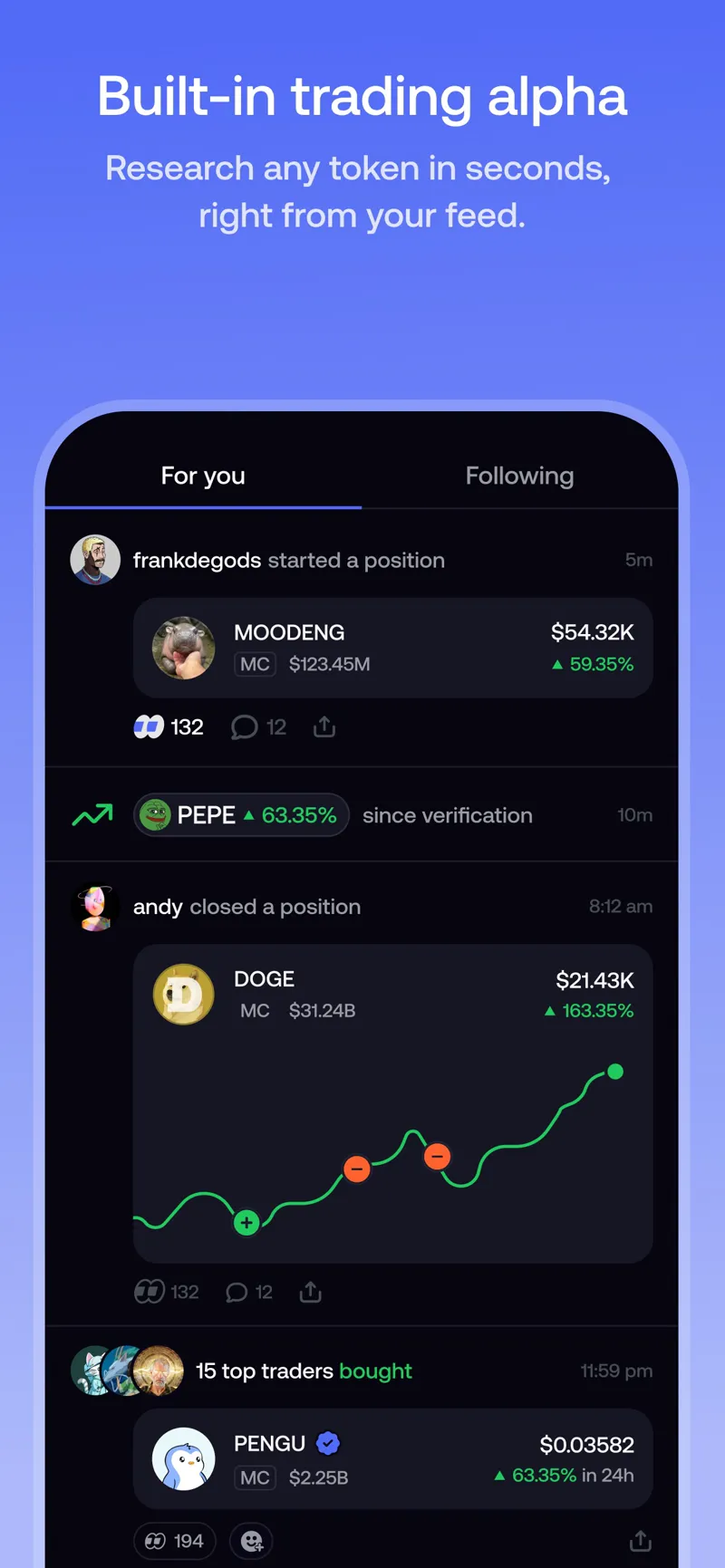
A social feed and a leaderboard do not copy trades for you. FOMO's help centre states that FOMO does not have a copy trading feature, so every order is one you place yourself. See what the feed, follow and leaderboard actually do on does FOMO have copy trading?, and what the app is built for on what is FOMO.
FOMO the app vs FOMO the feeling
FOMO Labs, Inc. named its trading app after the term this page explains. The app's own App Store listing calls it "fomo: never miss out." This page is about the trading feeling, which is older than any single app and applies on any platform.
For the app itself, read what it is and how it works on /app, and our independent look at whether it is safe to use on /is-fomo-legit.
Questions people ask
What does FOMO stand for in trading?
FOMO stands for fear of missing out. In trading, it means buying or selling an asset because you fear missing a price move, not because the trade fits your plan. Cambridge Dictionary defines FOMO as a worried feeling that you may miss exciting events other people are experiencing, often caused by social media.
Is FOMO the same as FUD?
No. FUD stands for fear, uncertainty and doubt: information, true or false, that pushes traders to sell or stay out. FOMO pushes traders to buy instead. Both are decisions driven by emotion rather than a plan. Both can move a price on their own, apart from any real change in a token.
How do day traders beat FOMO?
No trader removes FOMO completely. Common practices include a written entry and exit plan, set before the trade. Add a position-size limit that does not change for a fast-moving token, and a short wait rule between spotting a move and placing an order. A trade journal that records the reason for each entry also helps.
Is FOMO buying always bad?
A trade made during a rising price is not automatically a FOMO trade. FOMO buying is a trade made mainly from the fear of missing out, without research or a plan, often at a worse price than a planned entry would give. A trade that follows a plan set in advance, even in a fast market, is not FOMO buying.
What triggers FOMO in crypto and memecoin trading?
Live social feeds, leaderboards and price alerts trigger FOMO by showing other traders' gains in real time. FINRA's Investor Education Foundation found that 61% of investors aged 18 to 34 made an investment decision based on a social media personality's recommendation, against 6% of investors aged 55 and older.
Can experienced traders still feel FOMO?
Yes. FOMO is a general psychological pattern. Beginners and experienced traders both feel it. A Bank for International Settlements study found that new crypto exchange app users typically joined after Bitcoin's price had already risen. That pattern held across many kinds of users. Experience can reduce FOMO's effect on a decision. It does not remove the underlying urge.
Sources
- Cambridge Dictionary, FOMO.
- SEC Investor.gov, Say "NO GO to FOMO".
- Bank for International Settlements, Crypto trading and Bitcoin prices: evidence from a new database of retail adoption (BIS Working Papers No 1049), 14 November 2022.
- Bank for International Settlements, Crypto shocks and retail losses (BIS Bulletin No 69), 20 February 2023.
- FINRA Investor Education Foundation, New FINRA Foundation Research Examines the Characteristics, Behaviors and Outcomes of Retail Investors Who Use Social Media, 2 April 2026.
- FOMO Help Centre, Trading fees on fomo, 7 September 2026.
- FOMO Help Centre, Does fomo have copy trading?, 19 May 2026.
- Apple App Store, fomo: never miss out (FOMO Labs Inc.).